
# How Does IPTV Work? A Complete Technical Breakdown
If you look at the backend of a traditional RF (Radio Frequency) or satellite broadcast model, the logic is simple: push every available channel to the end-user simultaneously. The cable box sitting in the living room acts as a gatekeeper, simply tuning into the specific frequency of the requested channel while ignoring the rest of the massive, continuous data payload.
IPTV (Internet Protocol Television) flips this architecture entirely. Instead of pushing everything at once, IPTV utilizes a request-based packet delivery system over standard IP networks. The network only delivers the specific stream the user actively requests. This fundamental shift reduces the localized bandwidth requirement exponentially, enabling the delivery of massive channel libraries and ultra-high-definition content without requiring specialized copper or fiber deployments to the home.
So, exactly how does IPTV work under the hood? It relies on a tightly orchestrated sequence of data acquisition, encoding, middleware processing, and edge delivery. Here is the complete IPTV technical breakdown, walking you from the original satellite signal down to the decoded pixels on your screen.
The Core Architecture of an IPTV Network
Modern IPTV architecture requires four major pillars to function seamlessly. When you select a channel on your television, you are initiating a request that traverses these four distinct layers in a matter of milliseconds. This is not a simple file download; it is a continuously negotiated data stream governed by strict real-time networking protocols.
1. The Head-End (Content Acquisition)
The Head-End is the absolute starting point of the IPTV pipeline. It is the centralized, highly secure facility where raw video feeds are ingested, processed, and prepared for IP distribution.
* Signal Ingestion: Broadcasters acquire raw feeds via satellite downlinks, massive terrestrial antenna arrays, or direct fiber-optic cross-connects from the original content creators. These raw feeds are massive, uncompressed baseband video streams (often utilizing SDI—Serial Digital Interface).
* Transcoding and Encoding: Once ingested, the raw video must be converted into a digital format suitable for IP transport. Dedicated hardware encoders compress the video using advanced codecs like H.264 (AVC) or the newer H.265 (HEVC). HEVC is absolutely critical for 4K streaming because it relies on advanced block-based motion compensation, delivering high visual fidelity at half the bit rate of older standards. During this phase, encoders process I-frames (complete images) and B-frames/P-frames (data containing only the movement between images) to drastically reduce the data footprint.
* Packetization and Multiplexing: The encoded video, along with its synchronized audio tracks and subtitle metadata, is sliced into small IP packets, wrapped with UDP (User Datagram Protocol) or TCP (Transmission Control Protocol) headers, and handed off to the internal routing network.
2. The Video on Demand (VOD) Servers
While live TV operates on continuous, infinite streams, pre-recorded media requires a radically different infrastructure: dedicated VOD streaming servers.
* Storage Clusters: High-capacity NVMe and enterprise SSD storage arrays house petabytes of movies and series. Because VOD is heavily accessed during peak evening hours, the storage architecture relies on distributed file systems (like Ceph or Hadoop) to prevent I/O bottlenecks.
* Streaming Engines: When a user requests a movie, the VOD streaming server locates the file, initiates a dedicated session, and begins streaming the content incrementally. It supports standard playback controls like pause, rewind, and fast-forward by tracking the precise byte offset within the massive media file. The VOD servers often deploy Just-In-Time (JIT) packaging, transforming a single stored MP4 file into HLS or DASH on the fly, preventing the need to store multiple redundant copies of the same movie.
3. The Middleware (The Brain of the Operation)
If the head-end is the heart, the IPTV middleware is the brain. It is the complex software layer that sits between the backend infrastructure and the client-side device. The middleware governs the entire subscriber experience and acts as the gatekeeper for network resources.
* Authentication & Authorization: When you launch an app, the middleware instantly verifies your credentials. It checks your subscription status, validates your device's MAC address or active session token, and authorizes the stream. Fast in-memory databases like Redis are typically used here to handle thousands of concurrent authentication requests per second.
* Electronic Program Guide (EPG): The middleware aggregates schedule data (overwhelmingly formatted in XMLTV) from various metadata providers and distributes it to the client devices, populating the interactive channel grid.
* DRM (Digital Rights Management): Premium IPTV platforms integrate with DRM servers (like Google Widevine, Apple FairPlay, or Microsoft PlayReady) at the middleware layer. This ensures the stream is heavily encrypted, preventing unauthorized interception and pirating of the video payload.
* Billing and CRM: It handles the rigid business logic, tracking active concurrent connections to prevent account sharing and managing subscription renewals via backend PostgreSQL databases.
4. The Content Delivery Network (CDN)
Transporting high-bitrate 4K video across the globe from a single origin server would result in catastrophic network latency and endless buffering. The IPTV CDN is the essential solution.
* Edge Nodes: A CDN is a globally distributed network of reverse proxy servers. Instead of pulling the stream from the central head-end located in Europe, a user sitting in New York pulls the stream from a CDN edge node physically located in a Manhattan data center.
* BGP Anycast Routing: CDNs utilize Anycast routing to automatically map a user's IP address to the geographically closest edge server, minimizing the number of network hops required.
* Edge Caching: Edge servers aggressively cache VOD content and relay live streams, drastically reducing the physical distance the data packets must travel. This guarantees a high cache hit ratio and ensures smooth playback even during major live sporting events when millions of concurrent users hit the network simultaneously.
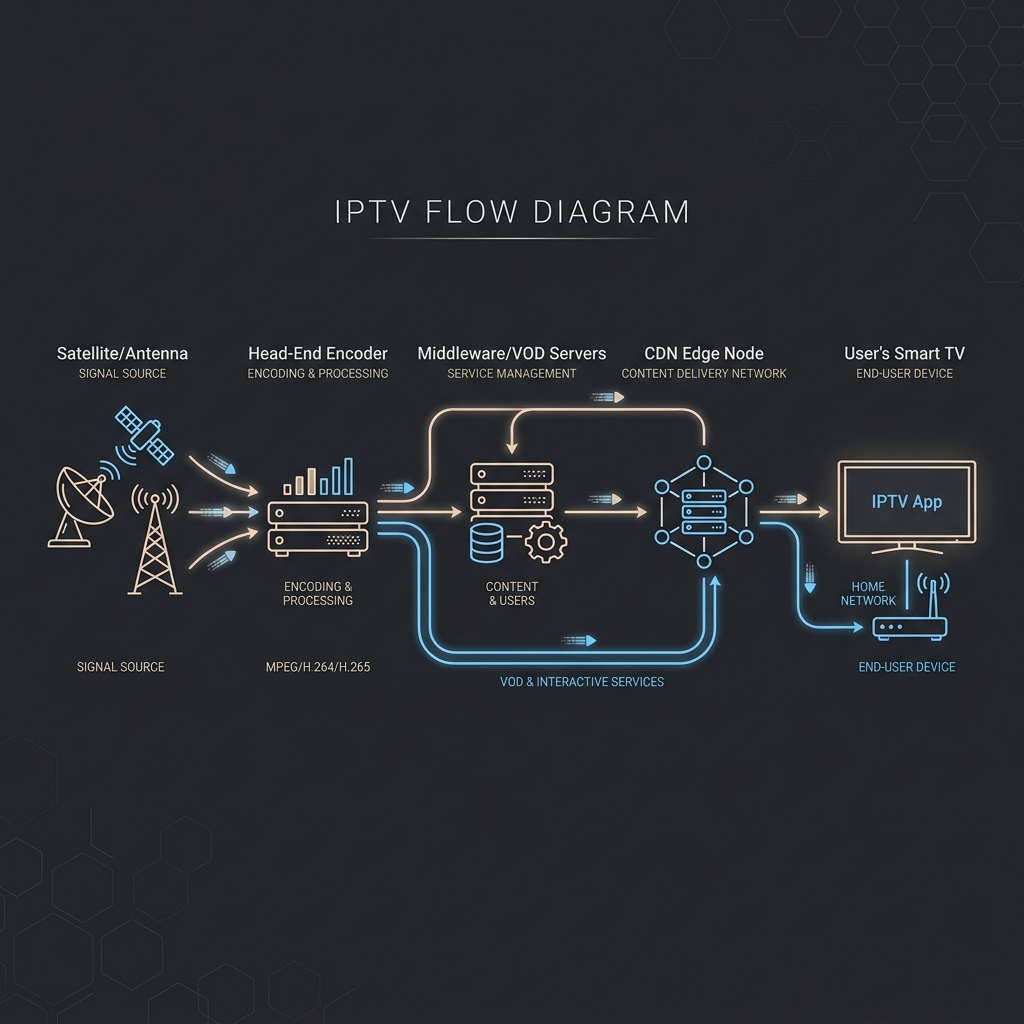
Unicast vs. Multicast: The Delivery Mechanisms
Network routing dictates exactly how data travels from the origin server to the end client. IPTV relies on two primary routing mechanisms depending entirely on the content type and the specific architecture of the Internet Service Provider.
Unicast Delivery
This is a strictly one-to-one connection. If ten users watch the exact same movie on a VOD server, the server must establish ten distinct, separate streams. Unicast is perfect for VOD because every user is at a different timestamp in the movie. However, it is highly bandwidth-intensive for the core server. Open internet IPTV services (often called OTT, or Over-The-Top) rely almost exclusively on Unicast because they cannot control the intermediary routers spanning the public web.
Multicast Delivery
This is a one-to-many connection utilized primarily for Live TV on closed, managed ISP networks (like AT&T U-verse or BT TV). A single master stream is sent from the server to a core network switch. Through a network protocol called IGMP (Internet Group Management Protocol), the switch duplicates the data packets and routes them to any user who has actively "joined" the channel group. If a million users watch the same live broadcast on a managed network, the core server still only outputs one stream. The heavy lifting of duplication is handled dynamically by the network switches at the edge.
The Essential Streaming Protocols
The transport protocol defines how the video packets are structured, segmented, and delivered over the web.
HLS (HTTP Live Streaming)
Developed by Apple, HLS is the undisputed king of modern streaming. It chunks the continuous video stream into small segments (usually 2 to 6 seconds long) and lists these segments in a dynamic `.m3u8` manifest file. Because it uses standard web traffic (port 80 or 443), HLS easily bypasses firewalls and is highly compatible across virtually all modern devices. Crucially, it supports Adaptive Bitrate (ABR) streaming, dynamically requesting lower-quality video chunks if the user's internet connection degrades, prioritizing continuous playback over raw resolution.
MPEG-TS (Transport Stream)
MPEG-TS is a legacy, incredibly robust standard initially designed for traditional digital broadcasting (DVB). It continuously wraps audio, video, and synchronization data into a single, cohesive stream. While it boasts significantly lower latency than HLS, it does not support adaptive bitrates natively and is far more susceptible to packet loss on unstable WiFi connections. When discussing HLS vs MPEG-TS, modern IPTV deployments overwhelmingly favor HLS for its resilience on the open web, reserving MPEG-TS mostly for internal head-end routing.
MPEG-DASH (Dynamic Adaptive Streaming over HTTP)
Functionally identical in concept to HLS, DASH also chunks video over standard HTTP connections. However, DASH is an open, codec-agnostic international standard rather than proprietary tech. While it is technically robust and heavily utilized by platforms like YouTube and Netflix, HLS remains more widely implemented in the standalone IPTV ecosystem due to Apple's dominant hardware influence.
The Presentation Layer: Middleware UI and Client-Side Tech
All the sophisticated backend engineering and global BGP routing means absolutely nothing if the end-user struggles to simply change the channel. The client-side application—the presentation layer—is where the technical backend meets human interaction.
Modern premium services utilize heavily optimized frontend frameworks to deliver a buttery smooth experience. Navigating a library of 28,000+ live channels requires an interface that does not choke the limited RAM available on standard Smart TVs or streaming sticks like the Amazon Firestick.
A modern 4K channel grid UI requires strict technical adherence to performance optimization:
* Asynchronous Data Fetching: The client app must load massive EPG XMLTV data in the background, rendering only the DOM elements currently visible on the screen to preserve tight memory constraints.
* Hardware Acceleration: The local player must offload video decoding directly to the device's GPU, bypassing the CPU to prevent device overheating, battery drain, and dropped frames.
* Premium Aesthetics: A photorealistic, premium dark UI is now the industry standard. Utilizing dark backgrounds, crisp modern typography, and subtle glowing highlights reduces eye strain in dark living rooms while giving the application an Apple-level polish. This aesthetic expectation separates premium services from outdated legacy providers.
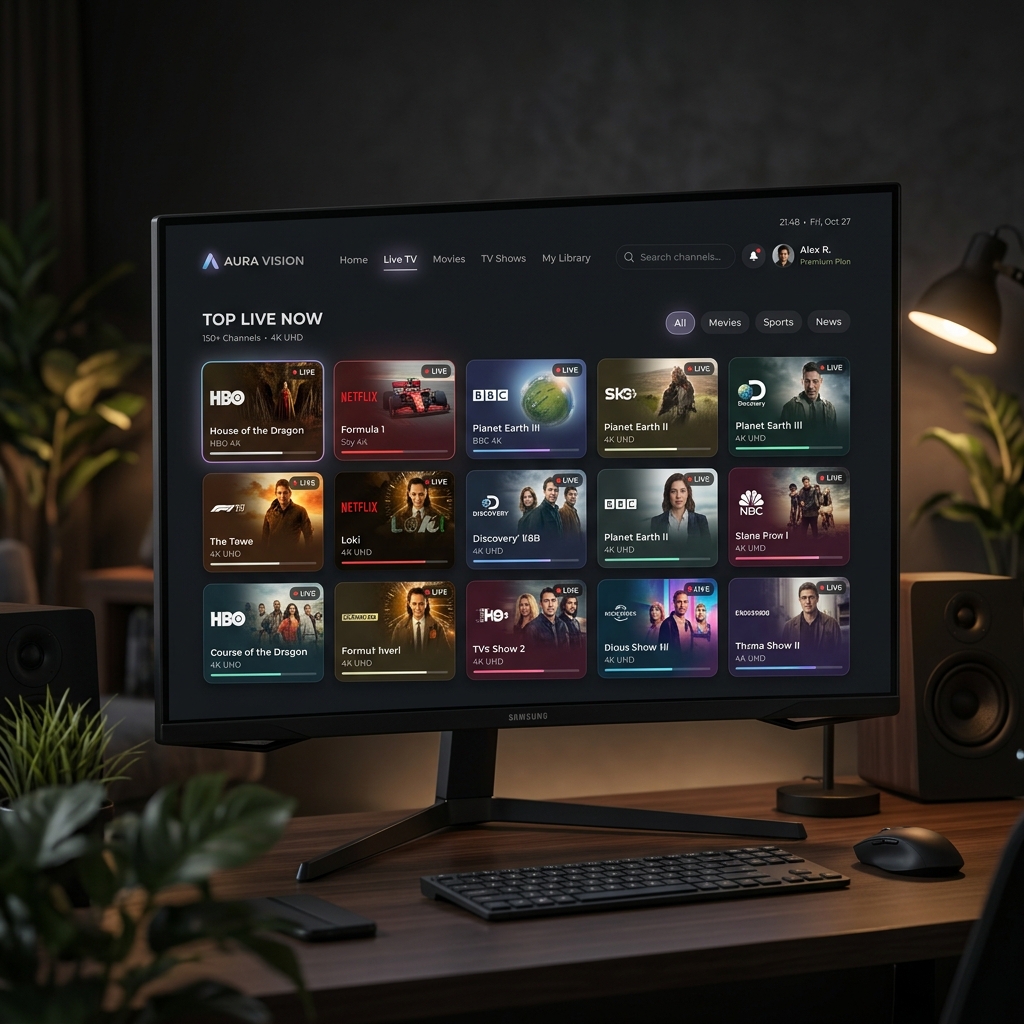
Future-Proofing IPTV
The core architecture is constantly evolving to meet the unyielding demands of higher resolutions, wider color gamuts, and aggressively lower latencies.
* AV1 Codec Adoption: The industry is slowly shifting from HEVC to AV1, an open-source, royalty-free video codec spearheaded by Google and Netflix that offers 30% better compression efficiency. This will enable flawless 4K HDR streaming over much slower internet connections.
* Ultra-Low Latency: Standard HLS inherently introduces a 15-to-30-second delay compared to live satellite broadcasts due to segment buffering. Emerging protocols like LL-HLS (Low-Latency HLS) and WebRTC are shrinking this gap to sub-second levels. This is a critical requirement for live sports betting, interactive broadcasts, and real-time social watching.
* AI-Driven Encoding: Machine learning algorithms now analyze video frames in real-time at the head-end, applying aggressive compression to static backgrounds (like a uniform soccer pitch) while preserving high bitrates strictly for fast-moving foreground objects (the players). This perceptual quality encoding drastically reduces bandwidth without sacrificing visual fidelity.
Conclusion
The journey from a live camera feed in a remote stadium to the glowing pixels on your living room television is a marvel of modern networking. By shifting away from the outdated broadcast "push" model to the highly efficient, request-driven IP model, the industry has unlocked a level of content scale and on-demand flexibility that traditional cable infrastructure simply cannot match.
For a complete look at how this technology outperforms older models, read our comprehensive IPTV vs Cable TV comparison, or return to varodatic to explore the ultimate implementation of this modern streaming architecture.
Related Articles

IPTV Internet Speed Requirements in 2026 — Real Numbers for 4K, Sports & Multi-Device
How much internet speed does IPTV actually need? SD to 4K HDR speed tables, multi-device household calculators, monthly data usage numbers, and why your 200 Mbps connection still buffers.
Read Article
Best IPTV Players for 4K Streaming in 2026
Discover the most reliable and feature-rich IPTV players optimized for seamless 4K streaming and zero buffering this year.
Read Article
IPTV vs Cable TV in 2026: The Complete Comparison
An honest, data-driven comparison of IPTV and traditional cable TV covering real costs, channel counts, video quality, and contract freedom.
Read Article